A 30-day programme for getting off vapes and pouches.
Not a puff counter. Not a streak you can lose. Not a plan written for cigarettes with the words swapped out.
Most people who end up stuck on nicotine pouches got there trying to quit something else. Vape to get off cigarettes, pouches to get off the vape, and then both. Every programme on the shelf is built around cigarettes, where nicotine replacement is the answer. If you are already on pouches, replacement is the problem.
How the thirty days are shaped
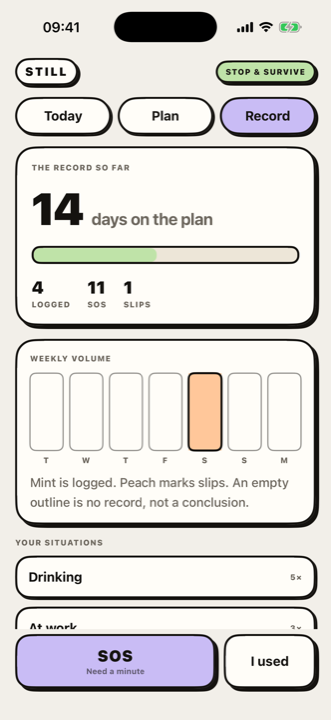
Days 1–5. You keep using. You log it, and nothing else. By day five you have a map of your own habit instead of a guess.
Days 6–14. You stop. This is the stretch that ends most attempts, and with pouches a lot of people report it landing later than the books say.
Days 15–30. For many people, the sharpest physical withdrawal has eased by this point; timelines vary. The work shifts toward routines and the situations that bring people back.
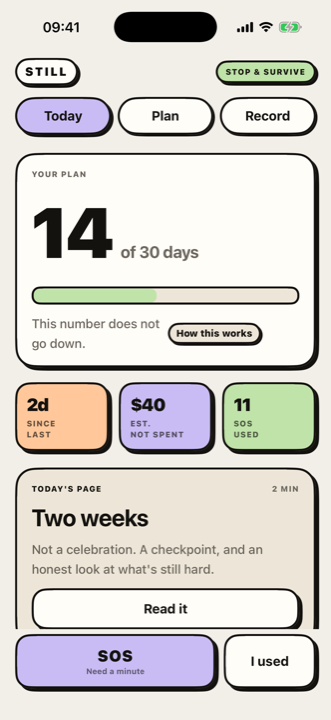
The day count never resets
If you slip on day twelve, you are still on day twelve. The moment is recorded on your timeline and the number stays where it is. There is no reset button in this app, and there is nothing to buy to protect a streak.
This is not a kindness, it is the point. Every app in this category sends you back to zero, and people delete them for it — "I'm ashamed of how many times I've pressed Reset all data" is a thread title that reappears year after year. A number that one bad evening can destroy is a number you stop looking at.
The switching trap
Pouches to quit vaping, vaping to quit pouches. It is the most common way this ends badly, and almost nothing is written about it, because the products are new and the cessation literature is about cigarettes.
What people describe is consistent: the replacement turns out to be the heavier dependency. More nicotine a day than before, a stronger hold, and now two habits where there was one. Still is built for someone using both at once — that is a first-class answer to the first question, and nothing afterwards makes you nominate a main one.
Ninety seconds
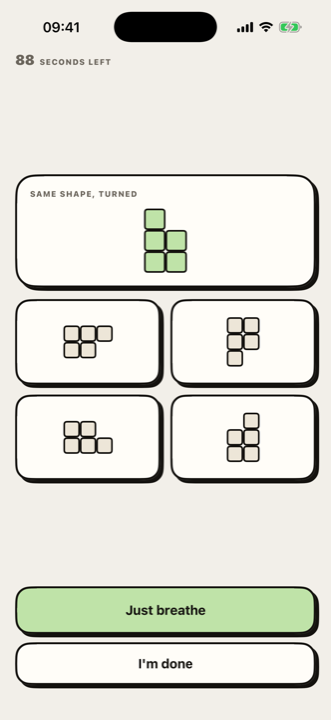
A craving rises, holds and drops, and it does that whether or not you use. The craving tool asks where you are, says one specific thing about that place, and then holds ninety seconds with you.
During those ninety seconds it gives you something to turn over in your hands: a small shape-matching task. That is not decoration. Cravings run on mental imagery — the taste, the hand movement, the first draw — and a visual-spatial task competes for the same working memory and degrades the picture. It is the mechanism behind the Tetris craving research (Skorka-Brown and colleagues, 2015, which found roughly a 14% drop in craving strength in everyday settings). Those samples are small and we are not going to claim more for it than that. But a bare countdown gives the image nothing to fight.
There are no points, no high score and no way to lose. It ends when the wave ends, not when you win.
What is actually in the thirty days
Every page is written and finished, and all thirty are named below. The complaint that dominates this whole category is paying to find out there was nothing behind the paywall. So here is the table of contents, before you spend anything.
- Don't quit today — today you only watch
- Count without judging — most people are wrong about how much they use
- Your four windows — use isn't spread through the day, it clusters
- What the urge is actually offering — most cravings are a request for something else
- Pick the one you'll drop first — one window, the easiest, and only that one
- The last one — no ceremony, no photograph. It is a Tuesday
- Two different problems — the chemical and the ritual are separate
- Ninety seconds — a craving has a shape
- This is the part nobody warned you about — week two is not a failure
- Anger is a withdrawal symptom — it isn't your personality returning
- Sleep, and why it broke — bad sleep now is not permanent damage
- The switching trap — the most common way this ends badly
- Drinking — alcohol asks for nicotine on your behalf
- Two weeks — a checkpoint, not a celebration
- The hand, not the head — what's left is mostly a gesture
- Your desk — the commonest pouch trigger is a flat afternoon at a screen
- Driving — a reflex tied to a place
- The people who don't know — quitting in secret costs something
- If you do tell someone — who to pick, and the sentence that starts a fight
- The money, honestly — the total is real but it rarely motivates
- Three weeks and flat — the most under-warned part of quitting
- Boredom — nicotine was filling gaps you never noticed
- One is not one — the arithmetic of "just one"
- Sport, gym, and the myth of focus — measured rather than felt
- The friend with a tin — decide the answer now, while nothing is happening
- Travel and disruption — when the routine breaks, the quit needs a rail
- What a slip actually is — physically nothing, mentally everything
- Your triggers, ranked — your own logged moments, sorted
- The next ninety days — where the risk sits after the first month
- You don't need this app — what to keep, what to delete
Nobody has to know
No account, no sign-in, no server. Everything stays on your phone. Notifications never mention nicotine, vaping or quitting, so a glance at your lock screen gives nothing away.
The cost of that promise is real, and we would rather state it than bury it: lose the phone and the history is gone, because no copy exists anywhere else.
What it costs
One payment. The App Store shows the price for your country and currency. There is no subscription. Nothing renews and nothing is ever charged again.
Free for good: the day counter, the log, the craving tool, your timeline, and the whole of day one. You read a complete lesson before anything is asked of you.
Paid: the other twenty-nine pages.
Questions people actually ask
How long does withdrawal from nicotine pouches last?
Timelines vary. Many people find that the sharpest physical symptoms ease over the first few weeks, while routines and triggers can last longer. We will not hand you a precise day-by-day curve for pouches specifically, because the evidence does not support one — see the next answer.
Why is week two worse than week one?
For a lot of pouch users it is. The honest position: pharmacokinetics confirm that a pouch releases nicotine far more slowly than a cigarette, and a plausible case can be built that this shifts the peak of withdrawal later. But no day-by-day study of people quitting pouches exists, so a later peak is a hypothesis, not a finding. The programme covers the whole window instead of promising a peak on a particular day.
I use both a vape and pouches. Is this for me?
Yes, and specifically. Both is a first-class answer to the first question, and nothing downstream makes you pick a main one.
Do I have to set a quit date?
No, and you are never asked for one. Almost every app in this category opens by demanding a date. People who are still off it a year later describe a mechanism rather than a moment, and most of them advise against the dramatic start.
What happens if I slip?
You record it, the day count stays exactly where it is, and the app stops talking about money and progress for a while. Nothing is taken away and there is nothing to buy back.
What Still does not do
- It is not medical treatment. It does not diagnose, prescribe, or replace advice from a doctor.
- It does not supply or recommend nicotine replacement. If you want patches or gum, that is a conversation with a clinician.
- It is not written for cigarettes. If you smoke and have never vaped or used pouches, a cigarette-specific programme will fit you better.
- It does not sync or back up, and it exists nowhere but your phone.
- It cannot make you want to stop. It is built for the part after you already do.
Still is behavioural support and general information. It does not diagnose or treat, and it is not a substitute for advice from a doctor. If you are pregnant, managing a medical condition, or using nicotine replacement or prescription medication, speak to a clinician about stopping.